
Underslung EOT Crane vs Regular EOT Crane: Key Differences Explained
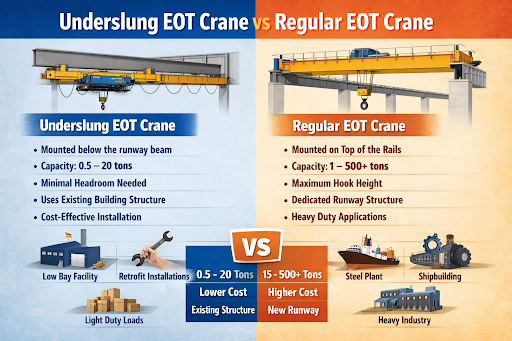
If you are considering the purchase of an overhead crane for your operation, the first thing your engineer or purchasing team will likely ask is: “Should we get an underslung crane or a standard EOT crane?”
It is an important consideration, and the wrong choice could mean wasted construction costs, poor headroom optimization, or worse: a crane that cannot meet your load requirements at all. In the following sections, we’ll explain the difference between an underslung crane and an EOT crane in simple terms, so you can make the right choice for your needs.
What is an EOT Crane?
An Electric Overhead Travelling Crane, also called a Bridge Crane or Overhead Crane, is equipment that is utilized for lifting and moving loads over considerable floor space within an industry. An EOT Crane runs on runway rails that are suspended from the top of the building or from freestanding columns.
EOT cranes are the lifeline of industries like heavy engineering, storage, steel plants, shipbuilding, automobile plants, and many other industries that require lifting, lowering, and moving loads over considerable floor space.
The major components of an EOT Crane include the Bridge (Main Beam), End Carriages (Wheels), the Hoist, and the Control System.
Read more about EOT crane here: What is an EOT Crane? A Complete Beginner’s Guide
What is an Underslung Crane?
An underslung crane is a particular type of EOT crane that runs on the bottom flange of the runway beam rather than on top of the rail. The end cars move along the bottom flange of the runway beam, and the crane hangs or is slung from the underside of the runway.
The underslung crane design allows the crane to utilize the existing framework of the building’s steelwork without the need for the construction of runway columns and rails. The hook travels at a lower height.
- Travels on the bottom flange of I-beams or structural steel runway
- Uses the existing building roof trusses or beams as the runway
- Has the advantage of lower hook heights
- Is typically suitable for loads of up to 10 tons; some are suitable for loads of up to 20 tons
- Is quicker and cheaper to install in an existing building.
Difference Between Underslung Crane and EOT Crane
Let us consider each of the above points in detail.
1. Structural Design and Mounting Position
This is the basic difference between the underslung crane and the EOT crane. For an EOT crane, the bridge beam is mounted above the runway rail, and the end carriage runs along the top of the rail. This is the normal configuration of an overhead crane used in most industries.
In the underslung crane, the end carriage is mounted on the lower flange of the runway I-beam, and the crane runs below it. This configuration uses the structural steel of the building itself as the runway rail.
2. Load-Carrying Capacity
The normal EOT crane is used in various industries to lift loads ranging from 1 ton in a workshop to 500+ tons in a steel plant.
In contrast, the underslung crane is limited by the load-carrying capacity of the existing structural steel in the building. It is generally used in the range of 0.5 tons to 10 tons. However, it is used in applications requiring loads of up to 15-20 tons.
For high-load applications, Double Girder EOT Crane and Steel Mill Duty Crane are used.
3. Installation Requirements
Installation of a regular EOT crane in a new or existing facility requires the construction of a new runway system. This includes columns, crane beams, and rails, requiring accurate tolerances. This is a large amount of work.
Installation of an underslung crane can be achieved by utilizing the existing structural steelwork of the building to form the runway. This can save a large amount of time and cost. The existing structural steelwork has to be approved by a structural engineer for the crane to be installed.
4. Cost
Underslung cranes have better cost efficiency for existing facilities with light to medium load conditions. The cost of installing an underslung crane is lower because it does not involve constructing a new runway. For new facilities or heavy load conditions, a regular EOT crane has better cost efficiency
| Feature | Underslung Crane | Regular EOT Crane |
|---|---|---|
| Capacity | 0.5 – 10 tons (up to ~20 tons) | 1 ton – 500+ tons |
| Mounting | Suspended from roof structure | Mounted on top of runway beams |
| Headroom Needed | Minimal – ideal for low bays | Requires more headroom (hook height) |
| Runway Structure | Uses existing building steel | Dedicated runway required |
| Installation Cost | Lower | Higher |
| Building Load | Lower stress on the structure | Higher structural demands |
| Best For | Light duty, retrofit, low headroom | Heavy-duty, new plants |
Applications: When to Use Each Crane
Underslung Crane – Best Applications
- Light manufacturing facilities where the ceiling height is low
- Maintenance facilities where a retrofitted crane solution is necessary
- Warehouse and logistics facilities for packages up to 10 tons
- Clean room, pharmaceutical, and electronic facilities
- Facilities where space considerations limit the use of columns for a runway beam
- Multiple crane facilities where a single runway beam serves multiple cranes in tandem
Regular EOT Crane – Best Applications
- Steel mills, foundries, and forging facilities
- Shipbuilding facilities and heavy fabrication shops
- Automobile and heavy vehicle assembly lines
- Power generation and transformer handling facilities
- Cement, chemical, and mining processing facilities
- New industrial facilities where overhead crane usage was a design requirement from the start
Which Crane is Right for Your Facility?
To help you decide, use this simple framework:
Choose an Underslung Crane if:
- Your load requirement is under 10-15 tons
- Your building has limited headroom or low roof height
- You want to retrofit a crane into an existing facility without having to do extensive structural changes
- Your existing building steel is strong enough to support the crane load (structural check must be done)
- Installation time and cost are important considerations
Choose a Regular EOT Crane if:
- Your load requirement is over 15-20 tons (and may increase in future)
- You are putting up a new building, giving you flexibility in the runway system
- Maximum hook height is needed for your operation
- Your operation is a high-utilization, heavy-duty operation
- Your industry is steel, shipbuilding, mining, power, or heavy manufacturing.
Conclusion
The main difference between the underslung crane and the regular EOT crane is based on only one thing: at what point the crane will run on the runway, and this single design factor controls everything else that follows.
For underslung cranes, the intelligent and cost-effective solution for light- to medium-capacity loads in existing spaces where space or headroom limitations exist, and for regular EOT cranes, the tried and true solution for heavy-duty industrial lifting with no limitations whatsoever, SBE Crane has the expertise and product offerings for the right solution for your specific application.

Founded in year 2002 by Mr. Rajan K Nair, who has been the backbone of the firm for the past 25 years with his vast experience of more than 30 years with designing, manufacturing, refurbishment, erection and commissioning of all kind of material handling equipment’s. .. Read More