
Types of Motors Used in EOT Cranes and How to Select the Right One
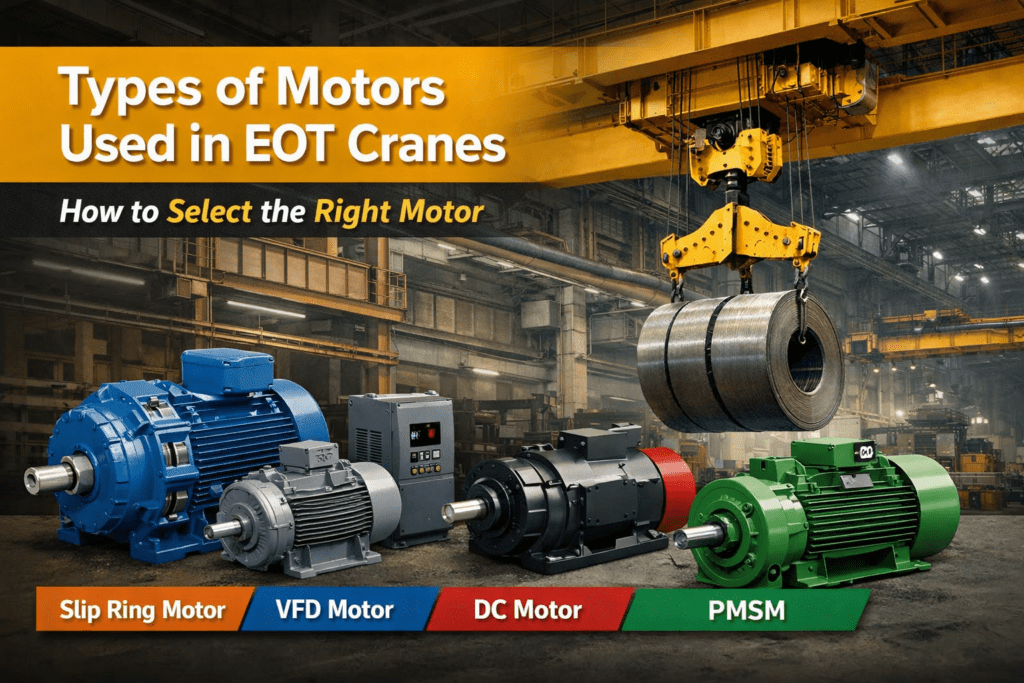
EOT crane motor selection is one of the most critical factors in determining crane performance, safety, and long-term reliability. Choosing the wrong motor does not just reduce efficiency, it leads to frequent breakdowns, higher maintenance costs, and serious operational risks in heavy industrial environments.
Electric overhead travelling (EOT) cranes are widely used in industries such as steel plants, shipyards, warehouses, foundries, and fabrication units, handling loads from a few hundred kilograms to several hundred tonnes. The performance of these cranes depends heavily on the efficiency and durability of the EOT crane motor used for hoisting, cross travel, and long travel motions.
There are several types of crane motors used in modern applications, including squirrel cage induction motors, slip ring motors, DC motors, and VFD-controlled crane motors. Each motor type is designed for specific load conditions, duty cycles, and control requirements.
In this guide, we will explore different crane motor types, their applications, and how to choose the right industrial crane motor for your EOT crane system.
Key Features of a Crane Motor?
A crane motor is an electric motor designed specifically for intermittent, high-torque duty. Unlike motors, crane motors start and stop repeatedly, handle varying loads, and often need to reverse direction.
Crane motors are designed with higher thermal capacity, reinforced insulation, stronger rotor construction, and a higher duty cycle rating – typically S3, S4, or S5 per IEC standards.
Key specifications you will see on a crane motor nameplate:
- Duty class (S3–S6) – indicates how often the motor can start and stop
- Cyclic duration factor (CDF) – percentage of time the motor is under load
- Insulation class – F or H class for crane duty
- IP rating – protection against dust and water
- Service factor – overload capacity
Most crane motors are rated for 40% or 60% CDF, meaning the motor runs under load for 40–60% of any given work cycle. Anything higher needs a de-rated or specifically oversized motor.
Also read: Essential Parts Of An EOT Crane
Motor Requirements for Different Motions in an EOT Crane
An EOT crane uses motors for three motions: long travel (the entire bridge moves along the runway), cross travel (the crab or trolley moves across the bridge beam), and hoisting (lifting and lowering the load).
Each motion has different torque and speed requirements:
|
Motion |
Torque Requirement |
Speed Requirement |
|
Hoisting |
High starting torque |
Moderate |
|
Long Travel |
Moderate |
Moderate to high |
|
Cross Travel |
Low to moderate |
Lower than long travel |
Hoist motors face the hardest conditions – full load starts, frequent reversals, and braking under load since they are directly connected to the lifting mechanism, typically a wire rope hoist system. That is why hoist motor selection is the most critical decision in any EOT crane specification.
Which Type of Motor is Used in an EOT Crane?
1. Slip Ring Induction Motor (Wound Rotor Motor)
This is the most commonly used motor in EOT cranes, especially for hoisting in medium to heavy-duty applications.
The slip ring motor has three external resistors connected to the rotor through slip rings. By varying the external resistance, you can control starting torque and current independently. This gives operators smooth, controllable acceleration even under full load – something squirrel cage motors cannot do without a VFD.
Why it works for crane duty:
- High starting torque (up to 200–250% of full load torque) with low starting current
- Speed can be adjusted in steps using rotor resistance
- Handles repeated starts and stops without overheating as quickly as cage motors
- Works well with conventional contactor-based controls
Typical duty class: S4, S5
CDF: 40–60%
Common applications: Steel plant EOT cranes, foundry cranes, shipyard cranes, heavy-duty workshop cranes
Limitations:
Slip rings and brushes need periodic maintenance. The external resistors also waste energy and all the speed reduction happens by dissipating heat in the resistors, not by reducing motor input power. This is a real efficiency cost in high-cycle operations.
2. Squirrel Cage Induction Motor (with VFD)
The squirrel cage induction motor paired with a variable frequency drive (VFD) is increasingly the preferred choice in modern EOT crane installations.
The cage motor itself has no brushes, no slip rings, no external resistors. It is simple, robust, and almost maintenance-free. The VFD controls the motor by varying the frequency and voltage of the supply, giving smooth, stepless speed control from near zero to full speed.
Why it works for crane duty:
- No brushes or slip rings – maintenance intervals are long
- Stepless speed control means precise load positioning
- Energy is not wasted in resistors; the VFD recovers braking energy back to the supply (with regenerative units)
- Works well with encoder feedback for closed-loop speed control
- Suitable for clean rooms, the food industry, and explosion-proof environments
Typical duty class: S4, S5, S6
Common applications: Precision cranes, automated cranes, process cranes in steel and aluminium plants, clean room overhead cranes
What to watch:
VFDs add cost. They also require proper protection. A VFD in a dusty foundry without an adequate enclosure IP rating will fail early. Motor cables need to be VFD-rated (low capacitance, screened) to avoid insulation damage from switching transients. The motor itself should also be inverter-rated with reinforced winding insulation.
3. DC Series Motor
DC series motors were widely used in older crane installations because they give very high starting torque and have a naturally soft starting characteristic. Speed drops as load increases, which is useful for hoisting because heavily loaded hooks automatically slow down.
Today, DC motors in cranes are mostly found in retrofit or legacy installations. New EOT crane projects rarely specify DC motors.
Why were they used?
- Very high starting torque without additional control equipment
- Simple speed variation with voltage control
- Natural load-speed droop useful for hoist control
Why are they less common now?
- Commutators and brushes require frequent maintenance
- Brushes produce carbon dust – a problem in clean or hazardous environments
- DC power supply infrastructure adds cost and complexity
- VFD-driven AC motors now match or exceed DC motor controllability
4. AC Crane Duty Motor (Direct-On-Line, Without VFD)
Before VFDs became affordable, many smaller EOT cranes used standard AC squirrel cage motors directly across the line with contactors. Speed was controlled by switching between different winding configurations (Dahlander winding for two-speed operation) or by using pole-changing motors.
This is still used in:
- Light-duty cranes (SWL up to 5–10 tonnes)
- Simple warehouse or workshop overhead cranes
- Applications where load positioning precision is not critical
The limitation is that every start draws 6–8 times full load current. In high-cycle applications, this stresses the motor thermally and mechanically, and it stresses the power supply network.
5. Permanent Magnet Synchronous Motor (PMSM)
PMSMs are used in newer, high-efficiency or compact crane applications where energy efficiency and precise control matter. They are more efficient than induction motors at partial loads, which is where crane motors spend most of their time.
These motors require a compatible servo drive or VFD with vector control. The combination gives excellent dynamic performance and positioning accuracy.
Current use cases are niche Mainly in automated storage and retrieval systems (AS/RS), robotic cranes, and specialised process cranes. For general EOT crane applications, they are not yet mainstream due to the higher initial cost.
Factors to Consider When Selecting a Crane Motor
1. Duty Class and CDF
Match the motor duty class to the actual operating cycle. Under-rating the duty class is the most common cause of premature motor failure in cranes. Calculate actual starts per hour and on-time percentage before specifying.
2. Starting Torque
For hoist motors, you need at least 150% starting torque to lift the rated load from rest. Slip ring motors and VFD-controlled cage motors both achieve this. DOL cage motor starters cannot control starting torque.
3. Load Type
- Light and uniform loads → Cage motor, possibly direct-on-line or soft start
- Heavy loads, frequent starts → Slip ring motor or cage motor with VFD
- Very precise positioning → VFD with encoder feedback, or PMSM with servo drive
4. Environment
- Dusty, dirty → Higher IP rating (IP55 or IP65), avoid brushed motors
- Hazardous area (flammable gases or dust) → ATEX or IECEx rated motor
- Outdoor → Weather-protected motor (IP55 minimum), tropical insulation treatment
- Foundry or steel plant → High temperature insulation, protected against radiation and scale
5. Control System
If your crane uses contactor-based control, slip ring motors are the practical choice. If you are installing a PLC or automation system, a VFD with a cage motor gives more integration options.
6. Maintenance Infrastructure
Slip ring motors work fine if you have electricians who know how to maintain brushes and slip rings. If maintenance resources are limited, a cage motor with a VFD reduces unplanned breakdowns.
7. Power Supply Quality
VFDs are sensitive to power quality issues. If your site has unstable voltage or frequent transients, either add line reactors and filters or consider slip ring motors, which tolerate supply variation better.
Common Problems in EOT Crane Motors
Overheating
The most frequent issue. Usually caused by exceeding the rated duty cycle, inadequate ventilation, or using a standard motor instead of a crane duty motor. Check CDF against the actual operating pattern.
Brush and Slip Ring Wear (Slip Ring Motors)
Brushes wear at different rates depending on current density, humidity, and cleanliness. Inspect every 3–6 months. Carbon dust from worn brushes can contaminate windings and cause insulation failure.
Bearing Failure
Crane motors take side loads and axial loads from brakes and couplings. Use bearings rated for the actual load direction. Over-greasing kills bearings as fast as under-greasing.
Insulation Breakdown
Repeated thermal cycling degrades winding insulation over time. Moisture ingress accelerates this. Annual insulation resistance (IR) testing with a megger will catch degradation early.
VFD-Induced Motor Failures
In cage motors driven by VFDs, high-frequency switching can cause bearing currents that erode bearing races. Use insulated bearings on the non-drive end, or a shaft grounding ring.
Brake Problems
Most crane motors have integral disc or shoe brakes. If the brake releases late or holds while the motor runs, the motor and gearbox take the damage. Test brake release time and braking torque during every major inspection.
Incorrect Motor Selection
Using a standard 4-pole industrial motor instead of a crane duty motor is a common cost-cutting mistake that leads to repeated motor failures. Crane duty motors are not significantly more expensive; the downtime cost is.
Conclusion
For most EOT crane hoisting applications, the choice comes down to two options: a slip ring motor with rotor resistance control for conventional systems, or a squirrel cage motor with VFD for modern installations. Both work reliably when correctly selected and maintained.
The slip ring motor is a proven technology that works well with contactor-based control panels and does not need a specialist to maintain. The VFD and cage motor combination gives better energy efficiency, smoother control, and longer motor life – but needs proper installation and someone who understands drive parameters.
For long travel and cross travel motions on most EOT cranes, a cage motor with a contactor or VFD is the standard choice.
Whatever motor type you select, match the duty class to your actual cycle, specify the right IP rating for your environment, and do not skip the brake and insulation checks during commissioning and maintenance.
FAQ
Q: Which motor is most commonly used in EOT cranes?
A: Slip ring (wound rotor) induction motors are most common in medium to heavy-duty EOT crane hoisting applications. For newer cranes, squirrel cage motors with VFDs are increasingly used.
Q: Can I use a standard motor for an EOT crane?
A: No. Standard motors are not designed for repeated starts, reversals, and braking under load. You need a motor rated for crane duty (S3–S5) with an appropriate CDF rating.
Q: What is the difference between a slip ring motor and a squirrel cage motor for crane use?
A: Slip ring motors allow external rotor resistance to control starting torque and speed, suitable for conventional contactor controls. Squirrel cage motors are simpler and more robust, but need a VFD for proper torque and speed control in crane duty.
Q: What does CDF mean in crane motors?
A: CDF stands for Cyclic Duration Factor. It is the percentage of time the motor operates under load in a given work cycle. A 40% CDF motor is on load for 40% and off-load or stopped for 60% of the cycle.
Q: How often should crane motors be inspected?
A: For slip ring motors, inspect brushes and slip rings every 3–6 months. Check insulation resistance annually. Bearings should be greased per manufacturer’s schedule – typically every 6–12 months, depending on operating hours.
Q: What is VFD crane motor control?
A: VFD (Variable Frequency Drive) control varies the frequency and voltage supplied to the motor to control speed and torque smoothly, without the energy losses of rotor resistance control. It gives better positioning precision and energy efficiency compared to contactor-based systems.
Q: What motor is used for the hoist mechanism in an EOT crane?
A: The hoist motor is typically a slip ring induction motor or a squirrel cage motor with a VFD. Both provide the high starting torque needed to lift rated loads. The hoist motor must be selected for the highest duty class since it performs the most demanding work on the crane.

Founded in year 2002 by Mr. Rajan K Nair, who has been the backbone of the firm for the past 25 years with his vast experience of more than 30 years with designing, manufacturing, refurbishment, erection and commissioning of all kind of material handling equipment’s. .. Read More