
End Carriages for EOT Cranes: Everything You Need to Know
If you run a factory, warehouse, or any heavy industrial facility with an EOT crane, you already know how much it depends on every single part working right. Most people think about the hoist, the hook, or the main girder when crane problems come up. The end carriage barely gets a mention until something goes wrong with it.
That is a mistake. End carriages are what actually move the entire EOT crane from one end of your bay to the other. They carry the full weight of the bridge, the trolley, and the load. When they fail, your crane does not just slow down it stops. And depending on the failure mode, it can do a lot of damage on the way out.
This guide covers what end carriages are, how they work, what types exist, what goes wrong with them, and how to keep them running. No filler, just what you actually need to know.
What Are End Carriages Used For In An EOT Crane?
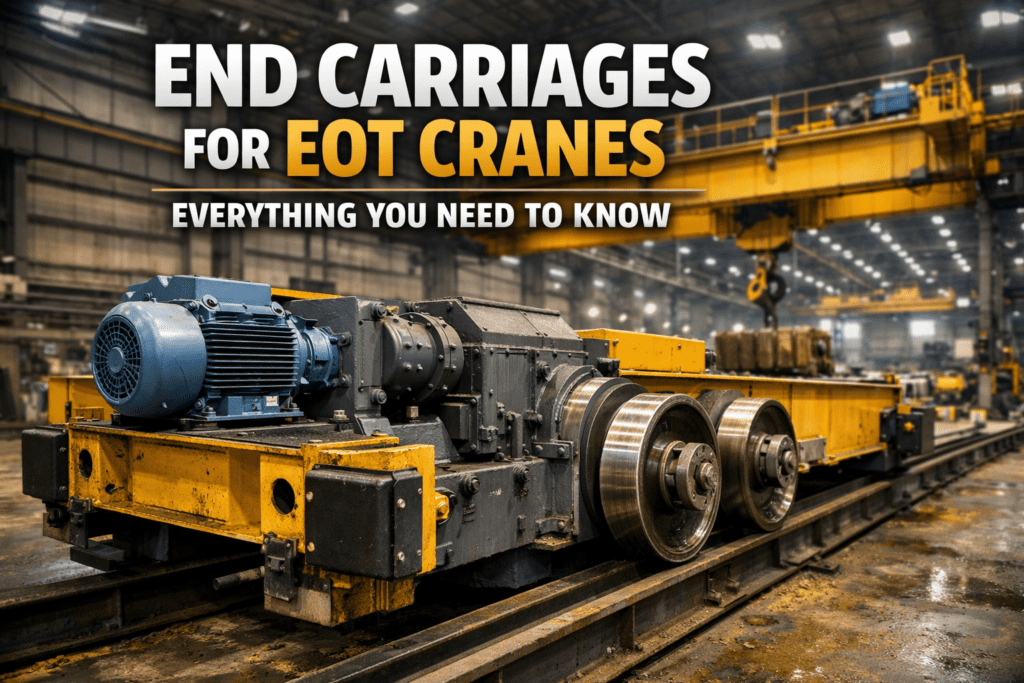
End carriages, also called end trucks or end beams, are mounted at both ends of the EOT crane bridge. Their job is to support the bridge structure and allow the entire crane to travel along the runway rails that run the length of your facility.
Think of it this way: the crane bridge spans the width of your bay, and the end carriages let it travel along the length. Without them, the crane is a fixed structure. With them, you get full coverage of your entire working area.
Every time your crane moves forward or backward along the runway, it is the end carriages doing the work. They house the travel wheels, bearings, motor drives, and gearboxes that make long travel motion possible. They also transfer all the vertical and horizontal loads from the bridge into the runway rails, which means they take a beating every single shift.
The length of end carriages typically ranges from 1.2 meters to 6 meters, depending on the crane’s lifting capacity, which can go from 0.5 tons all the way up to 100 tons for heavy industrial EOT crane applications.
Types of End Carriages
End carriages are not one-size-fits-all. The type you need depends on your EOT crane configuration, your facility layout, and your load requirements.
Single Girder End Carriages:
These are used with single girder bridge cranes with one main beam running across the span. Single girder end carriages are lighter and more compact. They work well for lighter capacities, typically up to around 20 tons, and are common in workshops, smaller warehouses, and manufacturing lines where headroom or budget is a concern.
Double Girder End Carriages:
Double girder configurations have two main beams, which means they need end carriages designed to connect and support both beams simultaneously. These are used for heavier capacities and longer spans. The end carriages on double girder cranes are larger, carry more load, and often have more complex wheel arrangements to distribute that load properly across the runway.
Top Mounted (On the Top) End Carriages:
In this design, the end carriages sit under the main beam, with the runway rail sitting below. One practical benefit is that the crane beam rides higher, which can help when you need to clear tall machinery or maximize hook height.
The downside is that the crane rails end up lower, which can be a problem if you have side access doors that vehicles need to pass through.
Side Mounted (Shear/Lateral) End Carriages:
Here, the end carriages attach to the side of the main beam. This configuration allows the runway rails to sit higher, which is useful when you need vehicles or equipment to pass under the crane rails from the side. Facilities with tight headroom between the crane rail and the roof eaves often go this route.
Suspension (Underhung) End Carriages:
These run on the bottom flange of an overhead beam rather than on a rail mounted on top of something. Used in light crane systems and monorail setups, they are compact and suited for lower capacity applications.
European Style End Carriages:
European-style end carriages follow FEM (Federation Europeenne de la Manutention) standards and are known for compact dimensions, modular design, and integrated inverter drives. They tend to have lower headroom requirements and are built for efficient, reliable long-term operation with less maintenance.
Inverter Driven vs. Two Speed End Carriages:
Older cranes often used two-speed travel motors. Most modern end carriages now use inverter (variable frequency) drives, which give smoother acceleration and deceleration, eliminate load swing, protect the brakes and gearbox from extreme wear, and allow you to adjust travel speed without mechanical changes.
Main Parts and Components of End Carriages
Understanding what is inside an end carriage helps you know what to inspect and what is likely to cause problems.
Steel Frame (Box Girder Structure):
The main body of the end carriage is a torsion-resistant box girder made from structural steel, commonly Q235B or similar low-alloy, high-strength material. This frame connects to the crane’s main girder through mounting plates and high-resistance bolts. The quality of this connection directly affects how the load transfers from the bridge into the wheels and rails.
Travel Wheels:
The wheels are what actually roll along your runway rails. They are usually made from forged carbon steel, sometimes with heat treatment for added hardness and wear resistance. Most bridge crane wheels have a double flange design to keep them guided on the rail. Wheel diameter varies depending on the crane’s weight class and load requirements. Larger diameter wheels handle heavier loads and last longer under repeated stress.
Axles and Bearings:
Each wheel sits on an axle, which is supported by bearings in a bearing housing. The bearings are one of the highest maintenance items on the end carriage. They need proper lubrication to prevent premature failure, and when they go bad, wheel alignment suffers quickly. Good quality end carriages use sealed or easily accessible bearing arrangements that simplify service.
Motor and Geaxrbox:
The drive unit that moves the crane along the runway is a motor paired with a gearbox. On modern end carriages, these are often combined into a three-in-one unit (motor, gearbox, brake) mounted directly to the wheel via a splined shaft. This direct drive arrangement reduces backlash and mechanical complexity. Some designs use exposed gear drives for larger force requirements.
Brake System:
The travel brake stops the crane when you release the controls. On inverter-driven systems, the brake does far less work because the drive itself decelerates the crane smoothly before the brake engages. On older two-speed systems, brakes take a much harder hit.
Bumpers:
High-grade rubber bumpers are bolted onto the ends of the end carriage. They absorb energy if the crane travels to the end of the runway and contacts the end stops. Good bumpers are bolted rather than welded, so they can be replaced without major disassembly.
Electrical Connection Points:
Modern end carriages have quick-disconnect electrical plugs so you can isolate and service the drive unit without dealing with a mess of wiring. This is a small detail that makes a real difference when you are trying to do a fast repair.
Connection Plates:
These are the plates that bolt the end carriage to the crane’s main girder. On single girder cranes, there is typically one connection plate per end. On double girder cranes, there are two. The precision of these plates matters; poor alignment here causes wheel deviation problems down the line.
Failure of End Carriages
End carriage failures are not random. Most of them trace back to a handful of recurring problems.
Rail Gnawing (The Most Common Problem)
Rail gnawing happens when crane wheels don’t move straight on the rail and instead rub hard against the sides. Instead of rolling smoothly, they grind sideways, which damages both the wheel and the rail.
You can usually hear it first — a rough hissing sound, and in worse cases, a loud metallic noise. You may also see shiny marks on the rail sides and rough edges on the wheel.
This usually happens due to misaligned wheels, uneven wheel sizes, a bent crane structure, improper rail alignment, or dirt and corrosion buildup.
Fatigue Cracks in the End Beam
When rail gnawing forces are significant, they create lateral loads that the end beam was not designed to carry continuously. Over time, this causes fatigue cracks at stress concentration points, typically near the wheel group support welds or at the connection between the end beam and the main girder. These cracks are serious and require repair by increasing the cross-sectional area of the beam and using plug weld reinforcement plates at the affected zones.
Bearing Failure
Bearing failure usually happens when there isn’t enough proper lubrication. Without it, heat builds up, parts start rubbing directly, and the bearing eventually gets damaged or stops working. Dust, moisture, and corrosive environments make this worse, so bearings used in harsh conditions like factories or chemical plants need more frequent checking and greasing.
Gearbox Problems
Low oil levels, contaminated oil (water or metal particles in the oil), and misaligned couplings are the main gearbox failure causes. Metal particles in the oil are a signal that gear wear is already happening. A gearbox running warm under normal conditions suggests a lubrication or bearing issue inside that needs attention before it becomes a full failure.
Uneven Wheel Wear
Wheels wear unevenly when they’re not properly aligned, when one side carries more load, or when the rails are uneven. This makes things worse over time, as more wear leads to more misalignment and faster damage. If the frame or bearing housing is also worn out, just changing the wheels won’t fix it. The whole carriage may need replacement.
Structural Corrosion
In humid, salty, or chemically aggressive environments, the steel structure of the end carriage corrodes over time. The closed box design of better quality end carriages resists this better than open section designs, but no design is immune without proper protective coating and periodic inspection.
How to Maintain End Carriages
Most end carriage failures are preventable. Here is a practical maintenance approach, broken down by frequency.
Daily (Operator Level)
Before each shift, listen and watch. If the crane makes any scraping, hissing, or grinding noise during travel, stop and investigate before continuing.
Check visually for any obvious signs of oil or grease leaking from the bearing housings or gearbox.
Note if the crane seems to drift or if travel feels rougher than usual.
These are early warning signs that catch problems before they become shutdowns.
Monthly (Maintenance Personnel)
Check wheel wear patterns. Uneven wear where one side of the tread is wearing faster than the other, or where the flanges show contact marks, is a direct sign of alignment problems.
Inspect bearings for proper lubrication and check for overheating using an infrared thermometer.
Lubricate all grease nipples on wheel bearings and motor bearings per the manufacturer’s schedule.
Check all mounting bolts on the end carriage and tighten any that have loosened. Loose bolts accelerate wear throughout the entire crane.
Check gearbox oil levels and top up as needed.
Inspect bumpers for compression set or cracking; damaged bumpers do not absorb impact properly.
Measure the gap between the wheel flanges and the rail sides. Per standard practice, this clearance should be between 10 mm and 15 mm on each side. If it is outside this range, you have either a wheel alignment issue or a rail gauge problem that needs correction.
Every Six Months
Do a full alignment check on the travel wheels, both horizontal deviation (wheel centre line vs. rail centre line) and vertical deviation (wheel tilt relative to plumb). Horizontal deviation should be within L/1000 of the measuring length, and vertical deviation within L/400. If either is out of range, wheel realignment or shimming is required.
Drain and inspect gearbox oil, check for metal contamination and water. Replace oil if it is degraded or contaminated.
Inspect all structural welds, especially at the girder connection points and around the wheel group mounting areas, for any cracks or signs of fatigue. Inspect the runway rails for lateral wear, surface damage, or gauge deviation that could cause gnawing.
Annual (Full Inspection)
Annual inspections should be carried out by qualified technical personnel, covering everything in the monthly and six-month checks, plus a full structural assessment.
This includes thickness measurements on the steel plate where corrosion is suspected, full motor and brake testing, and checking all electrical connections, including the quick disconnect plugs.
Document everything, as OSHA 29 CFR 1910.179 requires periodic inspection records for overhead bridge cranes. Facilities running cranes in severe service, heavy lift, continuous operation, or harsh environments should consider doing this more than once a year.
Final Thought
End carriages are not glamorous components. They sit at the ends of the crane doing repetitive, heavy work, and most people only think about them when something breaks. But they are one of the few components where a failure does not just reduce crane performance; it can take the whole crane out of service, damage the runway rails, and create a real safety risk for anyone working below.
Routine inspection, proper lubrication, alignment checks, and good documentation are not complicated. They are straightforward preventive steps that keep an end carriage running for its full design life rather than failing prematurely and costing far more in repairs and downtime than the maintenance would have.
If you are seeing noise, drift, uneven wheel wear, or visible rail marks, those are not things to watch and wait on. Get them checked and corrected early.
Need reliable end carriages for your EOT crane? Get in touch with us.

Founded in year 2002 by Mr. Rajan K Nair, who has been the backbone of the firm for the past 25 years with his vast experience of more than 30 years with designing, manufacturing, refurbishment, erection and commissioning of all kind of material handling equipment’s. .. Read More