
Crane Limit Switch: Types, Working, Importance & Maintenance Guide
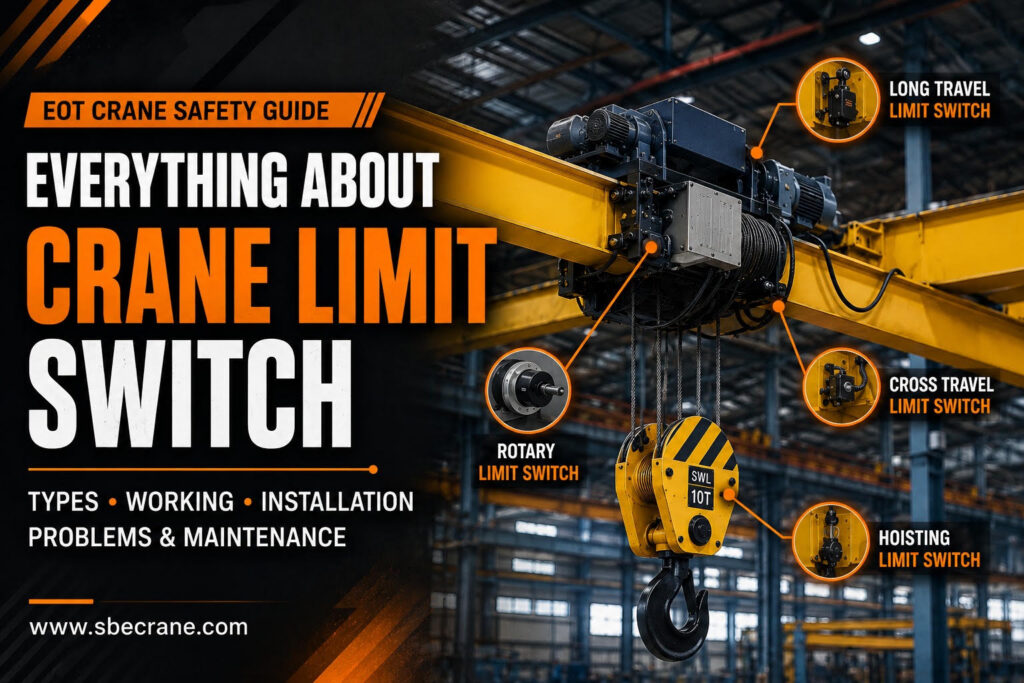
Have you ever wondered what prevents a crane hook from moving too high or stops an EOT crane from travelling beyond its designated path? The answer is the crane limit switch.
A crane limit switch is an important safety device that automatically controls the movement of different crane operations. It helps prevent over-travel of the hoist, trolley, or crane bridge, reducing the risk of accidents, equipment damage, and costly downtime.
Although it is a small component, the limit switch plays a vital role in ensuring safe and reliable crane operation. Without it, even a simple operating mistake can lead to collisions, damaged machinery, or serious safety hazards.
In this blog, you will learn everything about crane limit switches, including their meaning, working principle, different types, applications, benefits, common problems, and maintenance tips.
Also read: Essential Parts of an EOT Crane
Why is a Crane Limit Switch So Important?
If a crane operates without a properly working limit switch, it can lead to serious accidents, equipment damage, and costly downtime.
Some of the common problems that can occur include:
- The crane hook may move too high and hit the trolley or hoist.
- The crane bridge may travel beyond the runway and collide with the end stops.
- The trolley may move beyond its travel limit, increasing the risk of damage.
- The crane may operate unsafely, putting both workers and equipment at risk.
A properly installed and regularly maintained crane limit switch helps prevent these situations by automatically stopping the crane before it exceeds its safe operating limit.
For this reason, limit switches are a mandatory safety feature on EOT cranes and are widely used to ensure safe, reliable, and efficient crane operation.
How Does a Crane Limit Switch Work?
The working principle of a crane limit switch is straightforward.
A limit switch is connected to a moving part of the crane, such as the hoist, trolley, or bridge. As the crane operates, the limit switch monitors the movement of these components.
When the crane reaches its preset travel limit, the limit switch is automatically activated. It immediately cuts off the electrical supply to the motor, stopping further movement.
The motor stops immediately, preventing the component from travelling any further.
Once the operator moves the crane in the opposite direction, the limit switch resets automatically, allowing normal crane operation to continue.
The entire process takes place within a fraction of a second, helping protect the crane, the load, and the people working around it.
Types of Crane Limit Switches
Not all limit switches are the same. Different movements on an EOT crane require different types of limit switches. Choosing the right one for each application is essential for safe and reliable crane operation.
Here are the most commonly used crane limit switch types:
1. Hoisting Limit Switch (Upper & Lower Limit)
The hoisting limit switch is one of the most important safety devices in an EOT crane.
Its main function is to stop the hoist motor when the crane hook reaches its maximum lifting height or the lowest safe position.
Why it matters: If the hook moves too high, it can hit the trolley or hoist structure, damaging the wire rope, hoist, or other crane components. In severe cases, it may even cause the load to fall. A properly working hoisting limit switch prevents this by stopping the hook before it reaches these unsafe positions.
How it works: The limit switch is connected to the hoist drum or gearbox. As the hook moves up or down, the switch monitors its position. When the hook reaches the preset limit, the switch automatically cuts off power to the hoist motor, stopping further movement.
2. Long Travel Limit Switch (Bridge Travel)
The long travel limit switch controls the movement of the entire crane bridge along the runway.
Its main function is to stop the crane before it reaches the end of the runway. Without this limit switch, the crane could collide with the end stoppers, causing damage to the crane and increasing safety risks.
Why it matters: A long travel limit switch helps prevent accidents, protects the crane structure, and ensures safe operation, especially in factories where cranes travel long distances.
How it works: The limit switch is installed near the end of the crane runway. As the crane bridge approaches the preset limit, the switch is activated and automatically cuts off power to the long travel motor. This allows the crane to stop safely before reaching the end of the runway.
3. Cross Travel Limit Switch (Trolley Travel)
The cross travel limit switch controls the movement of the trolley across the crane girder.
The trolley moves from one side of the girder to the other to position the hook over the load. If the trolley reaches either end of the girder without stopping, it can run off the track, leading to a serious structural and safety risk.
The cross travel limit switch prevents this by cutting power to the trolley motor when it approaches either end of the girder.
4. Rotary Limit Switch
A rotary limit switch is an advanced type of crane limit switch that works by tracking the rotation of the hoist drum or travel mechanism. Instead of using physical contact, it measures the movement of the crane components to determine when the preset limit has been reached.
Where it is used:
- Heavy-duty EOT cranes
- Steel plants and foundries
- Ladle cranes
- Cranes that require precise lifting and positioning
Rotary limit switches are more durable and accurate than mechanical lever-type switches, making them the preferred choice for heavy-duty crane applications.
5. Gravity Type Limit Switch
A gravity type limit switch (also called a weighted lever switch) is one of the simplest and most common limit switches used to control the upper lifting limit of the crane hook.
How it works: The switch has a lever with a weight attached to it. As the crane hook reaches its maximum lifting height, it touches the lever, causing it to move. This activates the switch, which automatically cuts off power to the hoist motor and stops further upward movement.
Advantages:
- Simple design, easy to install
- Reliable and cost-effective
- Widely used in standard EOT cranes
Limitation: It is mainly used as an upper hoisting limit switch and is not suitable for applications that require high-speed or highly precise movement.
6. Screw Type Limit Switch
A screw type limit switch is commonly used to control both the upper and lower travel limits of the crane hook.
Why it matters: This limit switch helps prevent the crane hook from moving beyond its safe lifting or lowering limit. It improves safety, protects the hoist mechanism, and ensures smooth crane operation.
How it works: The screw type limit switch is connected to the hoist drum or motor shaft. As the drum rotates, a threaded spindle also rotates, moving a nut along the threads. When the nut reaches the preset position, it activates the limit switch and automatically cuts off power to the hoist motor.
Which Crane Limit Switch Should You Use?
Here is a quick summary to help you choose:
| Application | Recommended Limit Switch |
|---|---|
| Hook upper limit – standard cranes | Gravity type or screw type |
| Hook upper & lower limit – precise control | Rotary limit switch or screw type |
| Bridge (long) travel – end of runway | Lever-type or cam-operated limit switch |
| Trolley (cross) travel – end of girder | Lever-type or cam-operated limit switch |
| Heavy-duty cranes – steel, ladle, precision | Rotary limit switch |
Where Are Limit Switches Installed on an EOT Crane?
Limit switches are installed at multiple points on the crane. Each one is positioned to monitor a specific movement.
Here are the common installation locations:
- Hoisting limit switch – Installed on the hoist drum, gearbox, or near the crane hook, depending on the crane design.
- Long travel limit switch – Installed near the ends of the crane runway to stop the crane bridge before it reaches the end of its travel.
- Cross travel limit switch – Installed near both ends of the crane girder to control the movement of the trolley.
- Rotary limit switch – Installed on the motor shaft or gearbox to monitor the rotation of the hoist or travel mechanism.
If the switch is set too late, the crane may not stop in time and could damage the equipment. On the other hand, if it is set too early, the crane will stop before reaching its full travel range, reducing its efficiency.
Common Problems with Crane Limit Switches
Like any electrical or mechanical component, a crane limit switch can develop issues over time. Regular inspection and maintenance can help prevent unexpected breakdowns and improve crane safety.
1. Limit Switch Not Activating
Possible Causes:
- Worn or damaged lever
- Faulty internal contacts
- Improper alignment
Solution: Inspect and test the limit switch regularly. Replace it immediately if it does not operate correctly.
2. Limit Switch Activating Too Early
Possible Causes:
- Incorrect adjustment
- Mechanical wear
- Improper installation
Solution: Readjust the limit switch and test the crane’s complete travel range.
3. Limit Switch Stuck in the Tripped Position
Possible Causes:
- Jammed mechanism
- Broken return spring
- Dirt or debris inside the switch
Solution: Clean the switch assembly and replace damaged components if required.
4. Burnt or Damaged Contacts
Possible Causes:
- Frequent switching
- Electrical arcing
- Long-term wear
Solution: Inspect the contacts during routine maintenance and replace worn-out switches.
5. Dust and Moisture Damage
Possible Causes:
- Dust accumulation
- Water ingress
- Harsh working environment
Solution: Use IP-rated limit switches and inspect the housing and seals regularly.
Crane Limit Switch Maintenance Tips
The good news is that limit switch maintenance is straightforward. The key is consistency.
Monthly checks:
- Visually inspect all limit switches for physical damage, corrosion, or loose mounting
- Check actuating levers and mechanisms for wear or misalignment
- Observe crane operation for any unusual stopping behaviour
Quarterly checks:
- Manually test each limit switch by operating the crane to the limit position and confirming the motor cuts off
- Check and clean switch housings – remove dust, debris, or moisture
- Inspect wiring connections to limit switches for tightness and insulation condition
Annual checks:
- Verify the set position of each limit switch and re-adjust if required
- Inspect internal switch contacts for signs of burning, pitting, or wear
- Replace any switch that fails the functional test or shows visible internal damage
- Lubricate mechanical actuating parts where recommended by the manufacturer
How Long Do Crane Limit Switches Last?
The service life of a crane limit switch depends on the type of switch, the duty cycle of the crane, and the operating environment.
- Standard lever/gravity type switches in light-to-medium duty cranes typically last 3 to 7 years with regular maintenance.
- Rotary limit switches in heavy-duty applications can last 8 to 15 years if properly maintained.
- In harsh environments (dust, moisture, high heat), service life can be significantly shorter without adequate protection.
The best practice is to replace limit switches on condition, meaning based on test results and inspection findings, rather than waiting for a failure.
Conclusion: Don’t Overlook the Limit Switch
A crane limit switch is small, simple, and inexpensive compared to other crane components. But its role in crane safety is enormous.
It is the last line of defence between normal crane operation and a serious accident.
If your crane limit switches are not regularly inspected, properly adjusted, and replaced when worn, you are exposing your workers and your facility to unnecessary risk.
Here is what to take away from this guide:
- Understand the different crane limit switch types and make sure the right switch is installed for each application on your crane.
- Test all limit switches during every scheduled maintenance visit – don’t assume they are working.
- Never bypass a limit switch under any circumstances.
- Replace worn or damaged switches promptly. The cost of a new limit switch is a fraction of the cost of an accident or equipment failure.
- In harsh environments, always use switches with the correct IP protection rating.
A crane that is properly equipped and maintained with functioning limit switches is a crane you can operate confidently, day after day, shift after shift.
If you need help with crane maintenance, limit switch replacement, or a full crane inspection, get in touch with our team at SBE Cranes. We’ve been building and maintaining industrial cranes for over 25 years.

Founded in year 2002 by Mr. Rajan K Nair, who has been the backbone of the firm for the past 25 years with his vast experience of more than 30 years with designing, manufacturing, refurbishment, erection and commissioning of all kind of material handling equipment’s. .. Read More