
Types Of Crane Hooks: A Complete Guide To Different Hook Types
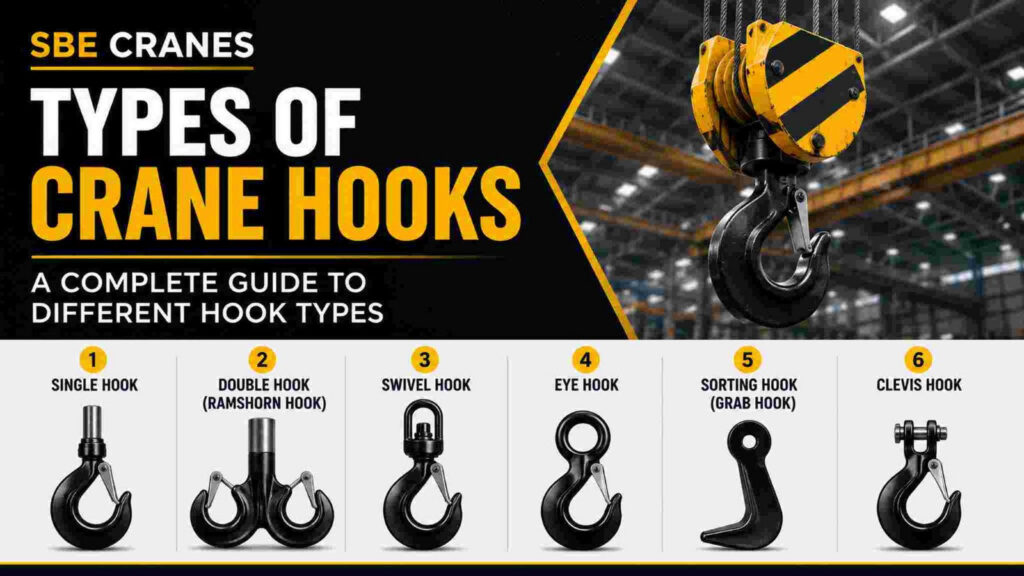
The crane hook is the final connection between your lifting equipment and the load, which makes choosing the right type important for both safety and lifting efficiency. Using the wrong hook can affect how safely and effectively the load is lifted.
Several types of crane hooks are used across industrial applications, including single hooks, double hooks (ramshorn hooks), eye hooks, swivel hooks, sorting hooks, and clevis hooks. Each type is designed for different load capacities, lifting conditions, and crane configurations, so the right choice depends on how and where the hook will be used.
In this guide, we cover the major types of crane hooks and explain where they are used, how they are constructed, what makes them safe, and what you should regularly inspect. Whether you are choosing a hook for a new crane or replacing an existing one, this guide will help you understand the key things you need to know.
What Is a Crane Hook and Why Does It Matter?
A crane hook is the load-bearing attachment point at the bottom of the hoist. It connects the wire rope and hook block assembly to the load, making it one of the most important safety-critical components of a crane.
Because the hook directly supports the load, a hook failure can cause the load to drop. This is why crane hooks must meet strict safety and quality requirements.
Crane hooks must be:
- Forged from high-strength alloy steel and never made from cast steel.
- Rated according to the crane’s Safe Working Load (SWL).
- Fitted with a properly functioning safety latch.
- Inspected regularly for cracks, deformation, and wear.
Every EOT crane, whether it is a single girder or double girder crane, depends on the correct hook specification. The hook must be suitable for the crane’s rated capacity and duty class to ensure safe and reliable lifting.
How Crane Hooks Are Made: Forged vs Cast
Before choosing a crane hook, it is important to understand how it is manufactured, as this affects its safety and strength.
Forged hooks are made by heating and pressing alloy steel into shape, which gives them high strength and better resistance to fatigue.
Cast hooks are made by pouring molten metal into a mould. They can have internal voids and may fracture under shock loading, so they are not recommended for industrial crane applications.
In India, crane hook material standards are governed by IS 15560, which covers alloy steel grades, proof load requirements, and dimensional tolerances.
Types of Crane Hooks
1. Single Hook
The single hook is the most common type of crane hook used across industrial applications. It has a single curved body with one lifting point.
Most standard EOT cranes, ranging from 1 tonne to approximately 80–100 tonnes, use single hooks as the standard configuration.
Key characteristics:
- Simple design that makes load rigging easy
- Available in fixed (shank) and swivel configurations
- Suitable for light, medium, and heavy-duty applications up to approximately 100 tonnes
- Fitted with a spring-loaded safety latch
Where it is used: Single hooks are commonly used in general manufacturing, warehouses, steel fabrication, automobile plants, and standard EOT crane installations.
One limitation of a single hook is eccentric loading. This happens when the load pulls unevenly to one side, putting additional bending stress on the hook body.
For very heavy loads, this can require a much larger hook body. For loads above 80–100 tonnes, a double hook is generally a better engineering solution.
2. Double Hook (Ramshorn Hook)
The double hook, also known as a ramshorn hook because of its shape, has two symmetrical hook bodies that share a common shank. This allows the load to be distributed across both sides, reducing the bending stress on a single point.
Because of this design, a double hook can provide a lighter and more compact structure when handling very heavy loads.
Key characteristics:
- Two lifting points for better load distribution
- Commonly used for heavy-duty cranes above 80–100 tonnes
- Significantly lighter than a single hook with the same rated capacity
- Used with two-leg wire rope reeving arrangements
Where it is used: Double hooks are commonly used in steel mill ladle cranes, heavy fabrication shops, shipyards, and large double girder EOT cranes designed for high-capacity lifting.
If you are specifying a crane for a steel plant or another heavy-duty application, the choice between a single and double hook depends on the rated capacity and duty class of the crane.
Our article on understanding the role of EOT cranes in steel mill operations covers the equipment requirements for these applications in more detail.
3. Swivel Hook
A swivel hook has a rotating mechanism built into its shank or connection to the hook block. This allows the hook to rotate freely under load and helps prevent the wire rope from twisting when the load swings or rotates during lifting.
Key characteristics:
- Rotates freely to prevent rope twisting
- Available in both single and double hook configurations
- Useful for long lifts and loads that rotate during handling
- Uses a thrust bearing to safely handle the rotational load
Where it is used: Swivel hooks are used when the load is likely to rotate, such as with long structural members, coils, and pipes, or when the load’s centre of gravity causes it to spin.
Wire rope hoists can particularly benefit from swivel hooks because repeated lifting without allowing the rope to rotate can cause it to coil and reduce its service life. This also makes swivel hooks closely related to wire rope health.
For more information on how hooks and wire ropes work together, see our resource on EOT crane spare parts, which covers hoist components and their replacement cycles.
4. Eye Hook
An eye hook has a closed, circular eye at the top instead of a traditional shank. The eye fits directly over a pin, bolt, or ring, creating a fixed connection between the hook and the lifting equipment.
Because the hook is attached through the eye, it is generally used where the hook does not need to be removed and reattached regularly.
Key characteristics:
- Provides a fixed mounting and is not intended for frequent rigging and de-rigging
- Lighter than shank hooks of the same capacity
- Used when the hook is permanently attached to a lifting beam or spreader bar
- Fitted with a safety latch or locking mechanism
Where it is used: Eye hooks are commonly used with lifting beams, spreader bars, and custom lifting fixtures. In these applications, the hook becomes a permanent part of the larger engineered lifting device rather than being attached and removed during regular lifting operations.
5. Sorting Hook (Grab Hook)
A sorting hook has a narrow, flat, and longer tip than a standard crane hook. This shape makes it easier to fit the hook into small gaps, slots, or spaces between materials that a regular hook may not be able to reach.
Key characteristics:
- Narrow tip that can reach small gaps and spaces between materials
- Designed to make direct contact with the load rather than being attached to a rope or sling
- Usually used for lower-capacity lifting
- Flat tip helps prevent the hook from rolling off the load
Where it is used: Sorting hooks are commonly used in warehouses and storage yards where individual materials need to be separated and lifted. They are useful for handling steel plate stacks, bar bundles, and scrap materials.
They are also used in paper mills and manufacturing units, especially when individual rolls or coils need to be picked and lifted.
6. Clevis Hook
A clevis hook is attached using a U-shaped clevis and a pin instead of a threaded shank. This provides a secure connection while also making it easy to install or remove the hook when needed.
Key characteristics:
- Uses a pin and clevis connection, making installation easier than a threaded shank
- Available with safety latches and locking clevis pins
- Suitable for applications where hooks need to be changed regularly
- Commonly used with chain hoists and light-duty wire rope hoists
Where it is used: Clevis hooks are commonly used in chain hoists, light-duty wire rope hoists, and portable lifting equipment. They are also useful for maintenance and repair work, where the hook assembly may need to be removed and replaced regularly.
If you are comparing hoist options along with different hook types, our guide on hoist vs crane explains how these components work together in a complete lifting setup.
Choosing the Right Crane Hook
| Hook Type | Capacity Range | Best For |
|---|---|---|
| Single Hook | Up to ~100 tonnes | General industrial lifting, most EOT cranes |
| Double / Ramshorn Hook | 80 tonnes and above | Heavy-duty cranes, steel plants, ladle cranes |
| Swivel Hook | Light to heavy duty | Loads that rotate, wire rope hoist applications |
| Eye Hook | Light to medium duty | Lifting beams, spreader bars, fixed fixtures |
| Sorting Hook | Light to medium duty | Scrap sorting, stacking, narrow-gap applications |
| Clevis Hook | Light duty | Chain hoists, portable hoists, maintenance |
The hook type you need is determined by your crane’s rated capacity, the nature of the load, and how frequently the hook is rigged and de-rigged.
Conclusion
The crane hook is a small component with enormous responsibility. Getting the type right and keeping it properly inspected is not optional. It is the foundation of safe crane operation.
To summarise:
- Use a single hook for standard EOT crane applications up to ~100 tonnes
- Specify a double hook for heavy-duty cranes above 80–100 tonnes
- Use a swivel hook wherever rope twist or load rotation is a risk
- Always ensure the safety latch is present and functional
- Replace – never repair – any hook that fails inspection criteria
If you need help specifying the right crane configuration for your factory – including the correct hook type and capacity – contact the SBE Cranes engineering team. We have been designing and manufacturing EOT cranes from our Ambernath facility for over 25 years.

Founded in year 2002 by Mr. Rajan K Nair, who has been the backbone of the firm for the past 25 years with his vast experience of more than 30 years with designing, manufacturing, refurbishment, erection and commissioning of all kind of material handling equipment’s. .. Read More